Running a Training Company Back Office: The Quotation-to-Invoice Workflow
· By Ayda Editorial

The back office most training companies actually run
A two-trainer training company in Petaling Jaya sends 40 quotations a month, runs 12 programmes and files about 9 HRD Corp claims. Every one of those jobs touches the same course title, the same trainer name, the same participant list and the same fee — and in most offices, that data is typed by hand at least four times before the money lands.
That repetition is where the admin cost hides. Not in the training itself, and rarely in the sales conversation, but in the handoffs between tools that were never introduced to each other. Below are seven handoffs in the admin chain where duplicate data entry and rework accumulate, each with a selection criterion, an effort or cost note in MYR, and a clear picture of who it suits.
1. Quotation built from a blank document
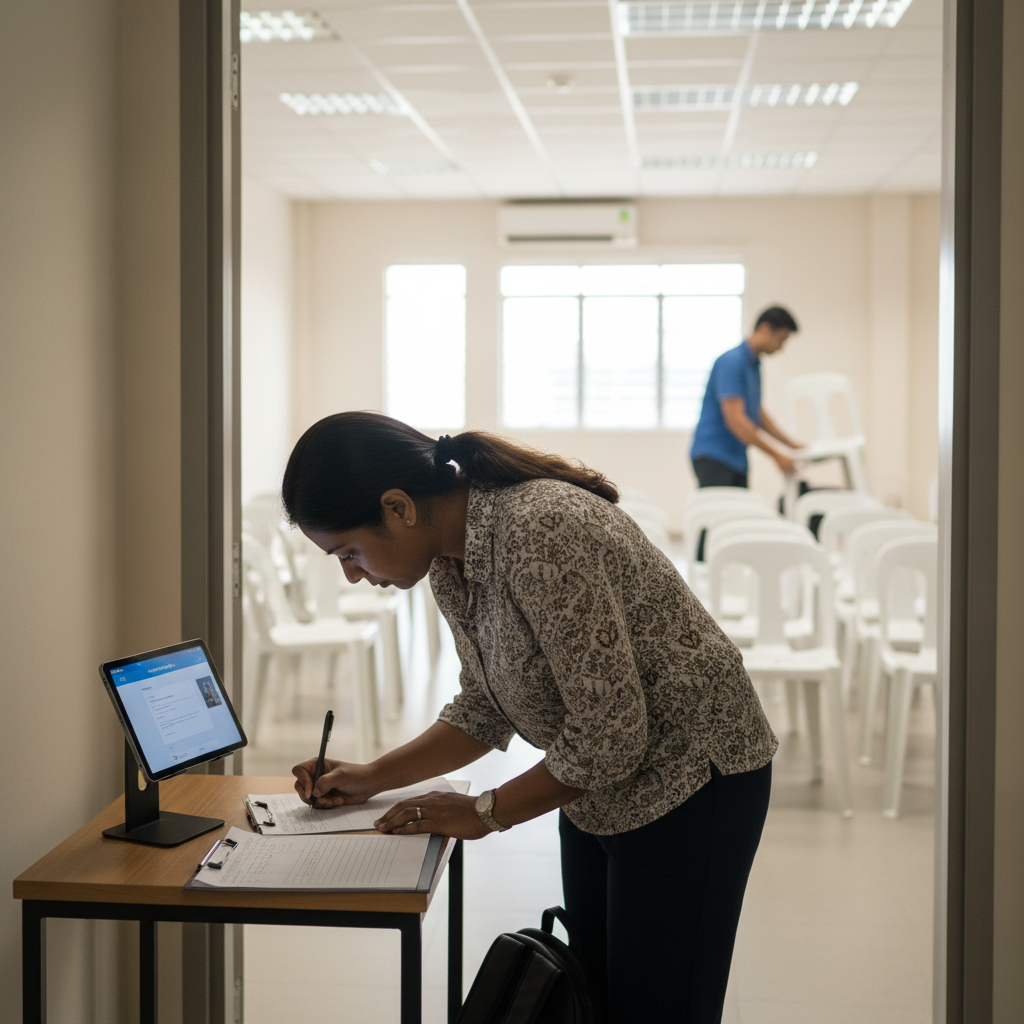 Capture participant names once at the door — certificates and claim files depend on it.
Criterion: the quote must carry course title, duration, participant cap, fee structure, HRD Corp claimability wording and validity period in one pass.
Effort note: a manual Word quote takes 25–45 minutes; a template library cuts that to 10–15 minutes but drifts out of date quickly when fees or scheme wording change. Purpose-built tools sit in between on cost — a full proposal tool or an ai training proposal writing setup typically saves the most on the 30–60 quotes a mid-sized provider sends monthly.
Who it suits: providers quoting more than 20 times a month, where one stale fee table on a template becomes a real commercial problem.
2. Quotation accepted, booking created from scratch
The single most expensive handoff. The client approves the quote by email, and an admin re-keys the course, dates, venue, trainer and participant estimate into a spreadsheet, a calendar and sometimes a second spreadsheet for the trainer.
Criterion: the booking record should be created by copying the approved quotation, not by retyping it. One source, one edit point.
Effort note: re-keying one booking takes 15–20 minutes. At 12 programmes a month that is roughly 4 hours of pure duplication, valued at around RM120–RM200 of admin time depending on seniority.
Who it suits: any provider where the person who quotes is not the person who books — the gap is where errors enter.
3. Trainer confirmation and the second diary
Trainers get confirmed by WhatsApp, and the confirmation never lands in the same system as the booking. Two weeks later nobody is certain whether the trainer knows the venue changed.
Criterion: the trainer's confirmation should update the programme record automatically, with venue, date, participant count and materials requirement attached.
Effort note: manual confirmation chasing costs 20–30 minutes per programme and is the leading cause of last-minute trainer dropouts. Providers using a trainer network — for example those who find HRDC trainers on Ayda — can cut the search time, but the confirmation step still needs to live in the workflow.
Who it suits: providers working with freelance trainers on a per-programme basis, where the trainer roster changes every month.
4. Attendance sheet to participant record
Paper attendance signed at the training room door, then typed into a spreadsheet the next morning. For a 20-person class that is 20 lines of typing, plus risk of misspelled names — which become misspelled certificates, which become HRD Corp claim queries.
Criterion: participant data should be captured once, ideally at registration or on a digital attendance form, and flow into both the certificate and the claim file.
Effort note: 30–45 minutes per programme for typing and checking. Digital attendance capture costs nothing extra if it is part of an existing platform, or RM5–RM15 per participant per programme through standalone attendance tools.
Who it suits: providers running public programmes with walk-in registration and providers with high participant volume per class.
5. Certificate generation
Certificates are the document participants notice and the document HRD Corp reviewers check. Name errors are embarrassing; missing certificate numbers are a claim problem.
Criterion: certificates generated from the participant record, never from a manually edited template. Name, course title, dates, trainer and certificate number drawn from the programme record.
Effort note: manual mail-merge takes 45–90 minutes for a 20-person class once you fix formatting errors. Ayda generates HRDC-ready certificates from templates as part of the platform, and standalone certificate tools run RM50–RM150 per month for small providers.
Who it suits: anyone issuing more than 50 certificates a month — the manual cost compounds fastest there.
6. Invoice raised from the quotation, not the booking
A quote was sent for 20 participants; 18 attended. The invoice is raised from the original quote because that is the document the admin has open. Now the claim file and the invoice disagree.
Criterion: invoice figures must derive from the delivered programme record — participants, days, fees — with the quotation as reference only.
Effort note: reconciling one mismatched invoice takes 20–40 minutes and often a phone call. Across 10 programmes a month, that is a full working day of cleanup nobody budgets for.
Who it suits: providers invoicing after delivery, especially those with variable participant numbers or multi-day programmes.
7. Claim file assembled from six places
Finally the claim: course outline, trainer profile, attendance, certificates, invoice and client confirmation, pulled from four folders and two email threads. This is the step where documentation errors become claim queries, and where most of the rework in the whole chain lands.
Criterion: the claim file should assemble itself from the records already created in steps 1–6. If any item has to be sourced from outside the system, the workflow has a gap.
Effort note: assembling one claim manually takes 1–3 hours. Providers running 8–10 claims a month are spending roughly two to three working days on assembly alone. HRD Corp documentation requirements also shift — the hrd corp 2026 changes training provider updates are worth reading before you lock in a format.
Who it suits: every registered provider, but the cost is acute for teams of one or two people where the same person sells, delivers and files.
Where the admin time actually goes, by role
| Role | Main duplication | Realistic weekly time lost |
|---|---|---|
| Owner / director | Reviewing quotes and claims for errors before sending | 2–4 hours |
| Admin executive | Re-keying bookings, attendance, invoices | 8–14 hours |
| Trainer / programme lead | Chasing confirmations, correcting outlines | 2–5 hours |
| Finance | Reconciling invoices against attendance | 3–6 hours |
For a small provider, that is roughly 15–28 hours a week of background admin — close to half a full-time headcount. At a junior admin salary of around RM2,800–RM3,800 a month in Malaysia, that is RM1,400–RM2,600 of monthly salary spent on rework, before counting the sales the owner did not make.
How the handoffs map to tools, in price order
- Spreadsheets plus folders (RM0): works until you pass about 8 programmes a month. The cost is your time.
- Template libraries (RM0–RM150/month): good if your team is disciplined about version control. Fails quietly when fee tables change.
- Standalone tools per step (RM300–RM800/month total): separate attendance, certificate and invoicing tools. Solves each problem but adds more handoffs between tools.
- Integrated provider platforms (RM200–RM600/month): one record from quotation to claim. The value is not the features — it is the absence of retyping. Ayda pricing sits in this band and includes HRDC-ready quotations, invoices and certificates.
A sequence that works without a big IT project
Do not automate all seven handoffs at once. Fix the one that costs the most and breaks the claim.
- Centralise the course and fee master. One record for each course title, duration and fee, used by every quote and invoice.
- Create bookings from quotations. Kill step 2 of the chain first — it is the simplest change with the clearest saving.
- Capture attendance digitally. Names then flow to certificates and claims without retyping.
- Generate certificates from the participant record. One click, one source.
- Build the claim from the programme record. If anything still needs assembling by hand, note it and fix that gap next.
Providers in their first 12 months should also keep the hrd corp training provider registration requirements at hand — claim document expectations are easier to meet when the workflow was designed around them rather than retrofitted. If you are scaling programme volume rather than fixing a bottleneck, review training programmes structures first, because a messy programme master makes every downstream step messier.
What to measure after 60 days
Track four numbers before and after: minutes from client approval to confirmed booking, minutes from delivery to invoice sent, minutes to assemble one claim file, and the number of claim queries per 10 claims. If the third number has not moved, the problem is not your tooling — it is the number of places the same data is still typed twice.
Most training companies do not need more software. They need fewer handoffs.
Frequently Asked Questions
How many times does a typical training provider re-enter the same data per programme?
In a manual setup, the same course title, trainer, participant list and fee are usually entered at least four times: in the quotation, the booking record, the attendance or certificate list, and the invoice. Each of those is a handoff where errors can enter.
How much admin time does the quotation-to-invoice chain cost a small Malaysian provider?
A two-trainer provider running around a dozen programmes a month typically loses 15–28 hours a week across owner, admin, trainer and finance roles. At junior admin salaries of roughly RM2,800–RM3,800 a month, that is RM1,400–RM2,600 of salary spent on rework each month.
Which admin step should a training provider automate first?
Start with creating bookings directly from approved quotations. It is the simplest change, needs no new regulation knowledge, and it removes the most repeated typing. Digital attendance capture and certificate generation usually come next.
Do I need to change my workflow if HRD Corp documentation requirements change?
Yes, if your claim documents are built by hand. When formats or requirements shift, a workflow with one programme record needs one update rather than several edited templates. Keeping up with the current rules will save rework when you file.
Can a small provider run this workflow without buying software?
For around 8 programmes a month or fewer, yes — spreadsheets and folders work, provided you maintain one course and fee master. Past that point the reconciliation time usually outweighs the cost of an integrated tool, which typically runs RM200–RM600 a month.